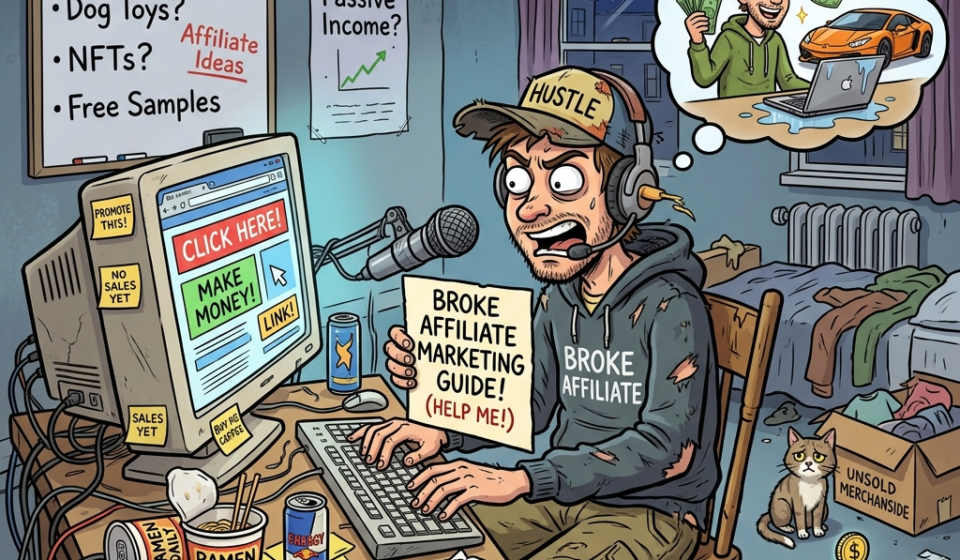
The Broke Person’s Guide To Affiliate Marketing: Starting With $0 And Questionable Hope

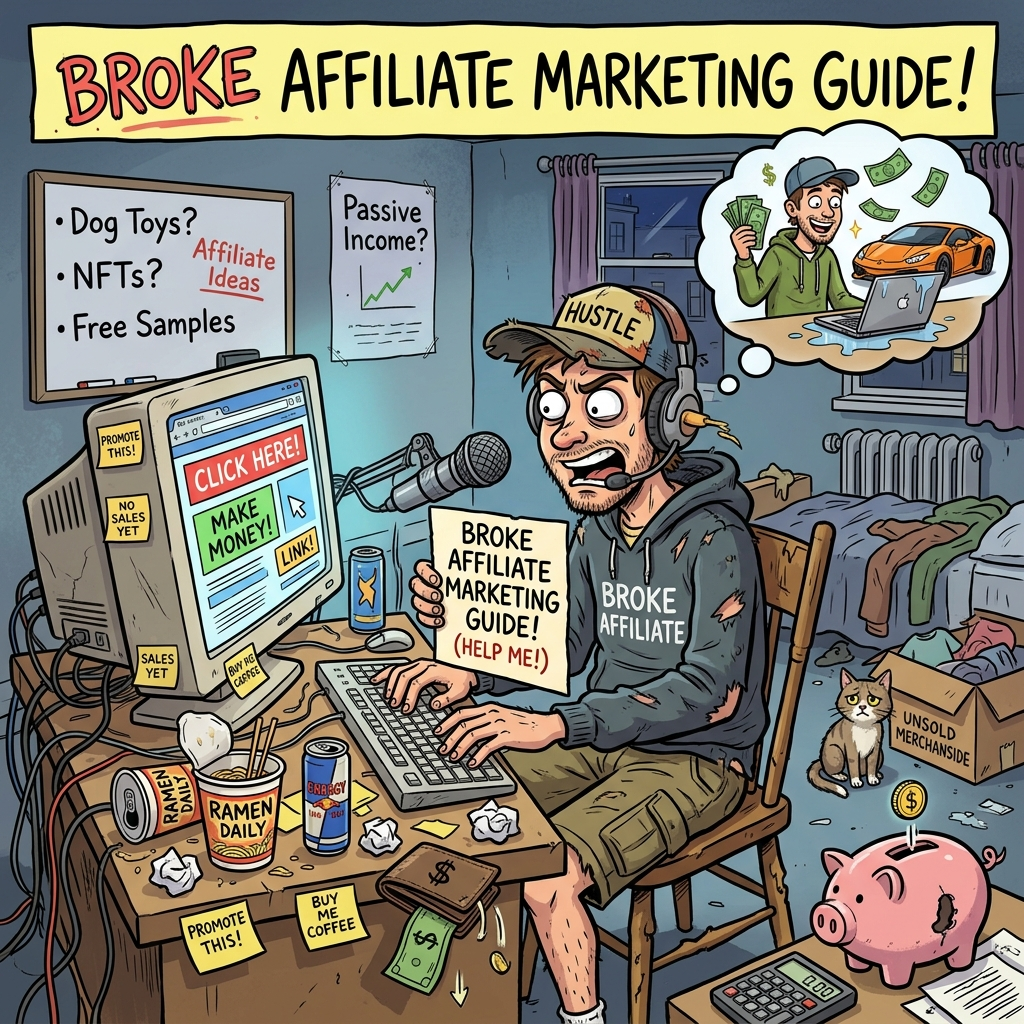
Let’s get one thing straight before we start: you don’t need money to make money with affiliate marketing. You’ve been lied to about a lot of things in the “make money online” space, but this one is actually true. The barrier to entry is genuinely zero dollars.
What you do need is time, a functioning internet connection, and the willingness to keep going after your first month earns you $2.47.
This guide is for people who are starting from scratch — no audience, no website (yet), no email list, no idea which products to promote, and no patience for a 4,000-word post that buries the actual instructions under motivational quotes. So let’s skip straight to the part where you learn what affiliate marketing is, how it works, and exactly what to do first.
What Affiliate Marketing Actually Is (In Plain English)
You recommend a product. Someone buys it through your unique link. The company pays you a percentage of the sale. That’s it.
You are not selling door to door. You are not cold calling anyone. You are not starting a dropshipping store or buying inventory or dealing with returns. You create content — a blog post, a YouTube video, a newsletter, a social post — that includes a link. When someone clicks that link and buys something, money appears in your account.
The percentage you earn depends on the program. Physical products on Amazon pay 1–4%. Digital products and software can pay 20–50%. Some recurring subscription products pay you every single month for as long as the customer stays subscribed. That last one is worth paying attention to.
The first time I got a $0.83 affiliate commission I thought it was a glitch. It wasn’t. It was just proof that the mechanism works — and the only question after that was how to turn $0.83 into something that actually mattered.
How The Money Actually Flows
Here’s the basic chain so you understand what you’re building:
- You join an affiliate program and get a unique tracking link
- You create content that genuinely helps people and includes that link naturally
- A reader clicks the link, visits the product page, and buys something
- The affiliate program records the sale and credits your account
- You get paid (usually monthly, via PayPal or direct deposit)
The tracking is handled by cookies — small files stored in the buyer’s browser that tell the company “this sale came from this affiliate.” Most programs have a cookie window of 24 hours to 90 days. Amazon’s is 24 hours, which is famously stingy. Most software affiliate programs run 30–90 days, which means someone can click your link today, think about it for three weeks, and you still get the commission when they finally buy.
Step 1: Pick A Niche (The Right Way)
The biggest mistake new affiliates make is treating niche selection like a personality test. “What am I passionate about?” is the wrong question. Passion doesn’t pay commissions. Demand does.
The right question is: what do people search for, where does buying something solve the problem, and do I have enough knowledge or curiosity to create useful content about it?
You’re looking for the overlap between three things:
- Topics with consistent search demand — people are actively Googling this
- Problems where a product is part of the solution — not every topic monetizes well
- Your ability to be credible or interesting — you don’t need to be an expert, but you need something to say
Some niches that consistently monetize well: personal finance, software and tech tools, health and fitness, home improvement, pets, outdoor gear, and — yes — making money online. That last one is what you’re reading right now. Meta, but it works.
Some niches that don’t monetize well despite being popular: general motivation, memes, news commentary, extremely broad lifestyle content. Lots of eyeballs, very little buying intent.
You don’t need a passion. You need a problem people are already trying to solve.
Step 2: Find Affiliate Programs Worth Joining
You have two main options: affiliate networks (which aggregate programs from hundreds of companies in one place) and direct programs (where you apply to a specific company’s affiliate program directly).
Start with these networks:
- Amazon Associates — the easiest to get started with, worst commission rates, but almost every product imaginable is on there. Good for building early content while you find better programs.
- ShareASale — huge network of mid-sized companies, strong in home goods, fashion, software, and services. Many programs pay 10–30%.
- Impact — where a lot of software and SaaS companies run their programs. Strong commissions.
- ClickBank — digital products, high commissions (often 50–75%), but quality varies wildly. Vet products carefully before promoting anything.
- PartnerStack — specifically for SaaS software. If you’re in a tech-adjacent niche, this is excellent.
Look for direct programs too. Most software companies — email marketing tools, website builders, course platforms — run their own affiliate programs with better commissions than anything on a network. Search “[product name] affiliate program” and you’ll find them.
What makes a good program:
- Commission rate above 20% (for digital) or above $15 flat (for physical/services)
- Cookie window of 30+ days
- Recurring commissions if it’s a subscription product
- A product you’d actually recommend to a friend without wincing
Step 3: Build Your “Home Base” (For $0 Or Close To It)
You need somewhere to put your content. Here are your options from cheapest to slightly-less-cheap:
Free options:
- Medium — write articles, include affiliate links (check their policy), build a reader base
- Substack — newsletter platform, free to start, great for building an email audience alongside your affiliate content
- YouTube — video content with affiliate links in descriptions, totally free to start
- Social media — Instagram, TikTok, Pinterest, and Twitter/X can all drive affiliate traffic with zero cost
Low-cost option (recommended long-term):
- Your own blog — a self-hosted WordPress site costs roughly $65–$100 per year for hosting and a domain. This is the best long-term move because you own it, Google can index it, and you’re building an asset instead of renting space on someone else’s platform.
If you’re genuinely at zero dollars right now, start on a free platform and move to your own blog once you’ve made your first $100 in commissions. Use your own money to fund the infrastructure you’ve already proven works.
Step 4: Create Content That Actually Converts
Here’s the content formula that works for affiliate marketing. It’s not complicated:
Help first. Sell second.
Content that converts is content that genuinely solves a problem. The affiliate link is the natural next step for someone who read your post, got value from it, and now wants to take action. If your content is good, the link feels helpful. If your content is thin, the link feels like spam.
The content types that drive affiliate sales:
- “Best [X] for [Y]” posts — “Best Email Marketing Tools for Small Businesses” — high buying intent, people are actively researching before a purchase
- Product reviews — “Honest Review of [Product] After 6 Months” — people searching for reviews are close to buying
- Comparison posts — “[Product A] vs [Product B]: Which Is Actually Worth It” — these catch people at the exact moment of decision
- Tutorial/how-to posts — “How To Set Up [Product] In 10 Minutes” — builds trust and naturally includes the affiliate link as a resource
- Problem/solution posts — “How I Stopped [Problem] Using [Solution]” — personal story format that converts well when the story is real
A note on disclosure: You are legally required to disclose affiliate relationships. Put a short, clear disclaimer near the top of any post with affiliate links: “This post contains affiliate links. If you buy through them, I earn a small commission at no extra cost to you.” This is both legally required and — more importantly — the right thing to do. Your audience’s trust is your only real asset.
Step 5: Get People To Actually See Your Content
Content with no readers earns nothing. This is the part that takes the most time and where most people quit.
Your main traffic options:
SEO (Search Engine Optimization) — write content around keywords people are already searching for, and Google sends you free traffic forever. Slow to start (3–6 months before significant traffic), but compounding and free. This is your long game.
Pinterest — massively underrated for affiliate marketers, especially in niches like food, home, finance, and DIY. Pins get found via search, which means your content has a longer shelf life than almost any other social platform. A pin you made 18 months ago can still be sending traffic today.
Email list — the best traffic source you can build because you own it. Start collecting emails from day one, even before you feel “ready.” A small, engaged list that trusts you will out-earn a large audience that doesn’t.
Short-form video (TikTok, Instagram Reels, YouTube Shorts) — fastest path to eyeballs, shortest shelf life. Good for building awareness quickly, but content burns out fast. Use it to drive people to your email list or blog, not as your primary monetization platform.
The honest answer on traffic: there’s no hack. Consistent publishing, understanding what your audience is searching for, and showing up regularly beats every shortcut. Most people who “fail” at affiliate marketing didn’t fail — they just stopped six weeks before it would have started working.
What Realistic Income Looks Like (Month By Month)
I’m going to give you the version no one puts in their thumbnail:
Month 1–2: $0–$25. You’re building content, getting indexed, figuring out what resonates. The affiliate clicks are starting. The commissions are not yet.
Month 3: $25–$150. If you’ve been consistent, you’re seeing real traffic and real commissions. Your first $100 month is in reach.
Month 6: $150–$600. Compounding kicks in. Old content keeps earning. New content earns faster because your site has authority now.
Month 12: $500–$2,000+. This is where it starts to feel like an actual income stream. The range is huge because niche, consistency, and content quality all matter enormously.
These numbers assume you’re working on this consistently — not six hours a week one month, nothing the next. Inconsistency is the single biggest killer of affiliate income potential.
Your first commission, whatever the amount, is not a number. It’s proof that the machine works. Everything after that is just turning up the volume.
The Fastest Path From Zero To First Commission
If you want your first dollar as fast as possible, here’s the shortest viable path:
- Pick a niche today. One you have something genuine to say about. Don’t spend more than 24 hours on this.
- Join Amazon Associates and one other program (ShareASale or Impact) that has products in your niche.
- Start a free Substack or Medium account and publish your first piece of content this week — a genuine, helpful post about a problem in your niche that naturally references a product.
- Write three more pieces of content in the next two weeks. “Best [X] for [Y]”, a product review, and a how-to guide.
- Share every piece in relevant Reddit communities, Facebook groups, and on Pinterest. Don’t spam. Be genuinely helpful and mention your content when it’s relevant.
- Collect emails from day one. Even a simple “subscribe for more” link is fine.
- Repeat until the first commission arrives. Then repeat again.
That’s it. That’s the whole strategy. The complexity people add on top of this is usually procrastination dressed up as preparation.
The One Mindset Shift That Changes Everything
Affiliate marketing rewards people who think like publishers, not salespeople.
A salesperson asks: “How do I get people to buy this?”
A publisher asks: “What does my audience actually need, and how do I help them get it?”
The publisher makes more money. Every time. Because trust converts, and trust is built by being genuinely useful over time — not by writing product descriptions with a lot of exclamation points.
You are not a promoter. You are a resource. The affiliate income is what happens when you do the resource part well.