

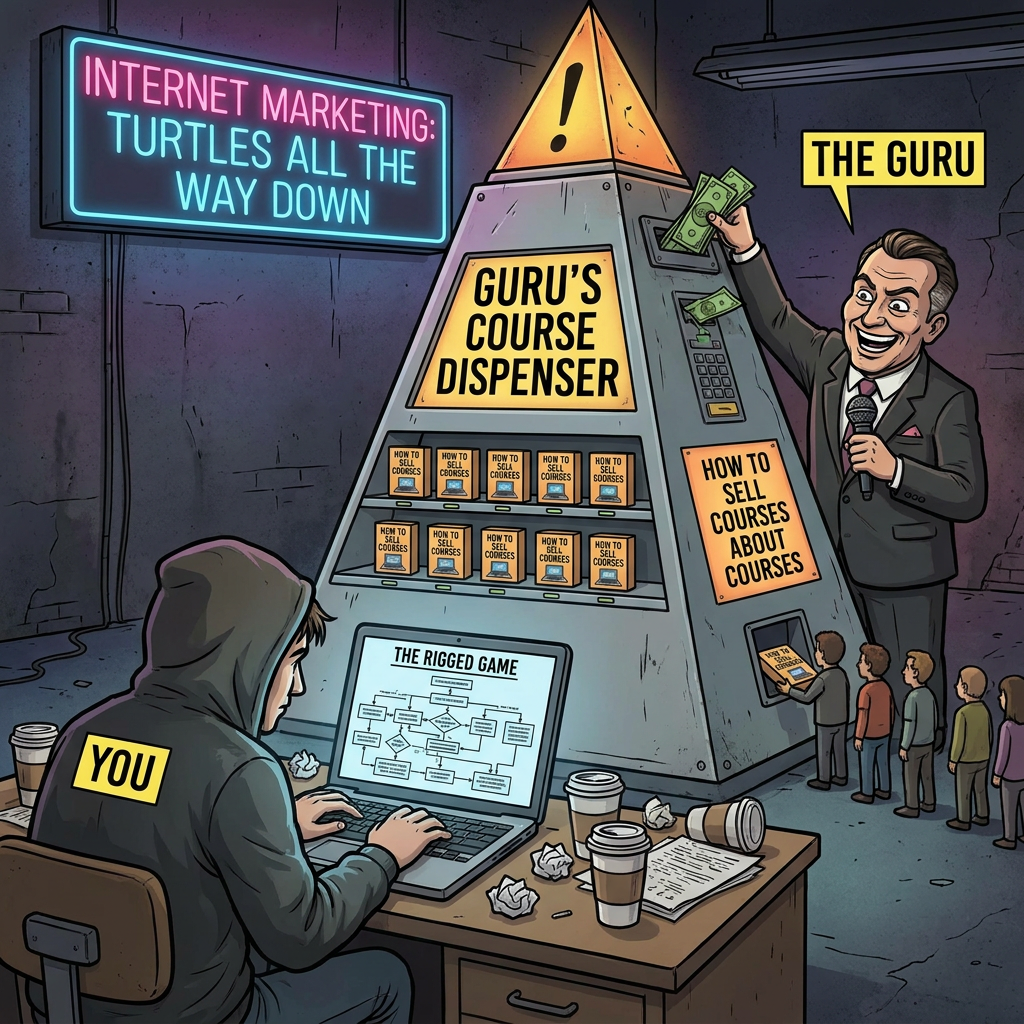
Let’s start with the uncomfortable truth nobody puts in their YouTube thumbnail: internet marketing is, at its core, a system designed by people who figured out how to make money first, then sold the map to everyone else at a markup.
The gurus got rich. Then they got rich again selling courses about how they got rich. Then a second wave of gurus got rich selling courses about how to sell courses. It’s turtles all the way down, and somewhere at the bottom of the stack is you, reading a blog post at midnight wondering if any of this is real.
Here’s the good news: it is real. The money is real. The strategies work. The part that’s a lie isn’t internet marketing itself — it’s the timeline, the ease, and the part where they forgot to mention how long they stared at a $0 dashboard before anything happened.
This is the actual guide. No Lamborghinis. No “seven figures in seven months.” Just how internet marketing works, what the pieces are, and how to put them together without losing your mind or your savings.
What Internet Marketing Actually Is
Internet marketing is the umbrella term for everything involved in promoting products, services, or content online in a way that generates revenue. That’s it. The rest is just subcategories.
Those subcategories include:
- Content marketing — creating useful content that attracts an audience and eventually sells them something
- SEO (Search Engine Optimization) — getting your content found on Google without paying for ads
- Email marketing — building a list of people who want to hear from you and monetizing that relationship
- Affiliate marketing — promoting other people’s products for a commission
- Paid advertising — paying platforms like Google or Meta to put your content in front of people
- Social media marketing — building an audience on platforms you don’t own (see: risky)
- Copywriting — writing words that make people take action (buy, click, subscribe, care)
- Conversion rate optimization — making the thing you built actually convert visitors into customers
Most beginners try to do all of these at once. This is how you end up exhausted, scattered, and $400 into tools you’ve opened twice.
The move is to understand how they connect — and then start with one.
The System Underneath Everything
Every internet marketing strategy, regardless of what it’s called, follows the same basic sequence:
Traffic → Audience → Trust → Offer → Sale
Someone finds you. They stick around long enough to care. You deliver enough value that they trust you. You make an offer. Some of them buy.
That’s the whole game. The complexity people add on top of this is usually one of two things: genuine refinement of each step, or expensive distraction dressed up as strategy.
Traffic is how people discover you. Organic search, social media, referrals, paid ads, word of mouth — there are many doors into your world. SEO and content marketing are the slow-but-compounding version. Paid ads are the fast-but-expensive version. Most people starting out should use organic traffic because it costs time instead of money, which is the resource most people can spare more easily.
Audience is what you build when traffic sticks around. A social media following is an audience you rent. An email list is an audience you own. The difference matters enormously when a platform changes its algorithm, bans your account, or simply becomes irrelevant — which they all eventually do.
Trust is built through content. Real, useful, honest content that treats your reader like someone who can detect when they’re being sold to and doesn’t appreciate it. Trust is also the thing that gets destroyed in one post if you recommend something terrible for a commission. The short-term money is never worth the long-term damage to the only asset that actually matters.
The offer is whatever you’re selling — your own product, an affiliate product, a service, a sponsorship. The offer only converts if the first three steps were done well. You cannot shortcut to the offer. You can try, but you’ll be annoyed by the results.
The Channels That Actually Matter For Beginners
You don’t need all of them. You need one that fits your skills, your patience, and your timeline.
If you like writing: Start a blog with SEO. Slow start, compounding payoff, lowest cost, best long-term ROI for people willing to be patient.
If you like talking: Start a YouTube channel or podcast. Longer ramp time, but video builds trust faster than text and the shelf life of a good YouTube video is years.
If you like writing short things: Start a newsletter and grow it with content marketing or social media. Email has the best conversion rates of any channel. The audience is smaller but warmer.
If you want the fastest path to revenue: Learn copywriting and freelance it. Skip the audience-building phase entirely and sell a skill directly to businesses who already have customers. You’ll be trading time for money, but the money comes fast.
If you have a budget: Paid ads can compress timelines dramatically — but only if you have a proven offer and some understanding of conversion. Running ads to a poorly-converting page is a fast way to donate money to Meta’s quarterly earnings report.
The Channels People Waste Time On
Social media as a primary strategy (for most niches): Building a following on Instagram, TikTok, or Twitter without converting that following into an email list or direct revenue is an expensive hobby. You’re creating content for a platform that will happily bury your reach the moment you stop paying for ads. Use social media to drive traffic to things you own. Don’t mistake followers for an asset.
Trying to rank for highly competitive keywords immediately: New blogs ranking for “best credit cards” or “how to lose weight” are not a thing that happens. Targeting low-competition, specific keywords is how you build early traffic. Save the competitive terms for year two.
Chasing every new platform: A new social platform emerges, everyone loses their mind about “first mover advantage,” and a thousand content creators rebuild their whole strategy around a platform that may or may not matter in 18 months. Post your best content on platforms where your audience already exists.
The Internet Marketing Lie You Need To Stop Believing
The lie isn’t that internet marketing doesn’t work. It does.
The lie is that the people teaching it have the same starting point you do.
When a successful marketer tells you they “started from zero,” they usually mean they started from zero followers on a new platform after years of developing skills, an existing network, a refined writing voice, an understanding of SEO, and the kind of confidence that only comes from already having succeeded at something.
That’s not zero. That’s a decade of accumulated knowledge wearing a “day one” costume.
Your actual day one is messier, slower, and more confusing than theirs — and that’s okay. The trajectory is the same. The timeline is longer. The strategy is identical: pick a channel, build an audience, earn trust, make an offer. Show up after the day it stops feeling exciting.
The people winning at internet marketing aren’t the ones who found the secret. They’re the ones who kept going after they realized there wasn’t one.