
Copywriting is the closest thing the internet has to a superpower — and it’s hidden in plain sight inside every email you’ve ever opened, every product page you’ve ever bought from, and every ad you’ve ever clicked and then been vaguely embarrassed about clicking.
It is also the most misunderstood skill in online marketing, wildly undersold in beginner content, and responsible for more of your favorite brands’ success than any designer, strategist, or social media manager will ever admit.
Here’s what copywriting actually is, how it works, and how to start developing it — even if the last thing you wrote that anyone read was a passive-aggressive note about dishes in the office sink.
What Copywriting Is (And What It Isn’t)
Copywriting is the craft of writing words designed to produce a specific action. Not to entertain. Not to inform. To move someone from where they are to somewhere you need them to be — clicking a button, handing over an email address, opening their wallet.
It’s the difference between:
“Our email marketing software helps businesses grow their lists.”
and
“Stop losing customers because you forgot to follow up. [Name] keeps the conversation going while you sleep.”
Both sentences describe the same product. One is information. One is copywriting. One makes you nod. One makes you click.
Content writing informs. Copywriting converts. Both are valuable. Only one of them is directly responsible for making the register ring.
The Psychology Underneath Good Copy
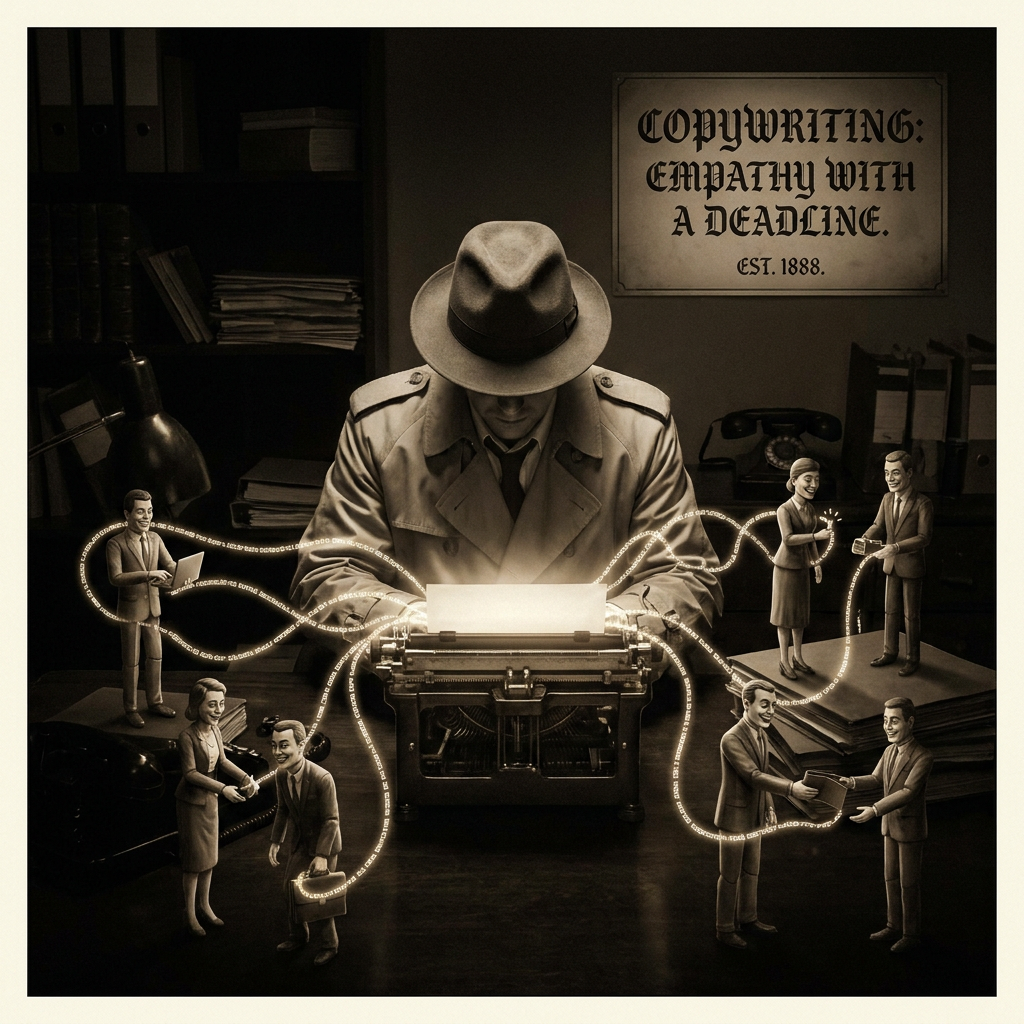
Good copywriting isn’t manipulation. It’s empathy with a deadline.
It works because it speaks directly to the thing the reader is already thinking — the problem they’re already aware of, the frustration they’ve already felt, the outcome they’re already imagining. It doesn’t create desire from nothing. It finds the desire that already exists and hands it a roadmap.
The psychological principles underneath most effective copy:
Specificity beats vagueness every time.“Lose weight” is forgettable. “Lose 11 pounds in 6 weeks without giving up the foods that make life worth living” is specific enough to be believed and remembered. The more specific your claim, the more credible it sounds — counterintuitive but consistently true.
The reader only cares about themselves.This sounds harsh. It’s actually liberating. Your reader does not care that you worked hard on your product, that your company was founded in 2019, or that you’re passionate about what you do. They care about one thing: what is in this for me? Every sentence in your copy should answer that question directly or be deleted.
People buy with emotion and justify with logic.The emotional case — “this will make your life easier / better / less stressful” — gets the click. The logical case — features, specs, testimonials — closes the deal after the click. Both matter. The order matters. Lead with feeling, follow with proof.
The fear of losing something beats the hope of gaining something.Loss aversion is real and copy that taps into it converts. “Don’t lose another customer to a slow follow-up” outperforms “Grow your customer retention by 40%.” Not because negativity sells, but because the cost of inaction feels more immediate than the benefit of action.
The Anatomy Of Copy That Converts
Every piece of effective copy — whether it’s an email subject line, a product page, or a Facebook ad — has the same basic structure:
1. The HookYou have approximately three seconds before someone scrolls past, closes the tab, or simply stops caring. The hook is your one job in that window. Its only function is to earn the next sentence.
The best hooks do one of four things:
- Make a bold, specific claim (“Most email advice is wrong — here’s the version that works”)
- Ask a question the reader is already asking themselves (“Why does everyone else seem to have this figured out?”)
- Open a loop the reader needs closed (“I made $1,200 from a single email. Here’s the exact one.”)
- Speak so directly to a pain point that the reader feels seen (“You’ve published 12 posts and Google still doesn’t know you exist.”)
2. The ProblemExpand on the pain. Not to make people feel bad — to demonstrate that you understand exactly what they’re dealing with. When a reader thinks “this person gets it,” your credibility doubles. This is the empathy part of “empathy with a deadline.”
3. The AgitationMake the cost of the problem clear. What happens if nothing changes? What does the reader continue to lose — time, money, opportunity, sleep — if they don’t act? This isn’t about fear-mongering. It’s about making the status quo uncomfortable enough that change feels worth it.
4. The SolutionIntroduce your offer as the logical answer to the problem you’ve just made vivid. Don’t lead with features. Lead with outcomes. Not “our software has automated follow-up sequences” but “never lose a sale because you forgot to follow up.”
5. The ProofTestimonials, case studies, screenshots, data, specific results. The emotional case got them here. The logical proof closes them. One specific, real testimonial beats ten vague five-star reviews every time.
6. The Call To ActionOne action. Clear, direct, low-friction. Not “feel free to reach out if you’d like to learn more” — that’s the copy equivalent of ending a date with “we should hang out sometime.” Tell them exactly what to do: “Click here to get instant access.” “Download the free checklist.” “Join 3,000 people who get this every Tuesday.”
The Copywriting Formats You’ll Use Most
Email subject lines:The most important copy you’ll ever write. If nobody opens the email, the world’s best body copy is irrelevant. The best subject lines are specific, curious, or shamelessly honest. “I made a mistake” outperforms “Monthly Newsletter Issue 14” by a margin that would make you want to cry into your analytics dashboard.
Email body copy:Write like a human. One idea per email. Short paragraphs. A clear CTA at the end. The goal of every marketing email is to get one click on one link. Not seventeen links. One.
Product page / sales page copy:The long-form version of the hook-problem-agitation-solution-proof-CTA structure above. The length should match the price point — a $9 product needs less convincing than a $297 course. Give people enough information to say yes, but not so much that they get bored and say nothing.
Blog post CTAs:The most overlooked copy on most blogs. The button text “Click Here” has converted worse than “Get The Free Checklist” in every A/B test ever run. Be specific. Tell them what they get, not what they do.
Social captions:Hook in the first line — because most platforms collapse the text after two lines. Write the first sentence as if it’s the only sentence that will be read. Then earn the “read more.”
How To Start Getting Better At Copywriting Right Now
Read your copy out loud. Every sentence. If you stumble, the sentence is too long, too convoluted, or too much in love with itself. Rewrite it until you can read it smoothly at normal speaking pace.
Collect swipe files. Save every piece of copy that made you stop scrolling, open an email, or buy something you didn’t entirely need. Don’t just save it — dissect it. Which part of the hook made you look? What was the emotional trigger? How did the CTA create urgency without fake scarcity? You’re building a reference library for your own writing brain.
Study the classics. David Ogilvy’s Confessions of an Advertising Man. Gary Halbert’s newsletters. Eugene Schwartz’s Breakthrough Advertising. These were written before the internet existed and are still more useful than 90% of modern copywriting content, because they’re about human psychology — which has not been updated since the Bronze Age.
Write more, polish less. The first draft of any copy is a discovery document. You don’t know what the best hook is until you’ve written seven of them. Write fast, edit slow, publish before perfect.
The sentence-length trick: Your copy should have rhythm. Long sentence to set up a complex idea. Short sentence to land it. Like this. Alternating length creates pace, makes reading feel effortless, and keeps attention moving forward without the reader noticing why.
The Uncomfortable Thing About Copywriting
The more you learn about copywriting, the more you’ll notice it everywhere — and the more you’ll realize how much of your own decision-making is shaped by it.
The email that made you buy that course you didn’t finish. The product page that convinced you the $97 version was clearly the right choice. The limited-time offer that made you move faster than you’d like to admit.
Knowing the tricks doesn’t make you immune to them. It makes you better at using them — and slightly more suspicious of everything you read, including this post.
That’s the deal. Copywriting is a skill, a craft, and a minor psychological superpower. Use it to write honestly about things worth buying, in words that make it genuinely easy for the right person to say yes.
Or use it for evil. This is the internet. Both options are well-documented.